Most AI operations (AIOps) discussions focus on IT environments, but modern enterprises depend on much more than servers and applications. Physical infrastructure, operational technology (OT), production systems, facilities, and critical assets all contribute to business continuity.
This creates a growing need for IT/OT convergence, where IT operations management (ITOM), IT asset management (ITAM), and physical asset intelligence work together. Enterprises using IBM Maximo often manage thousands of physical assets, but the question remains: is the infrastructure supporting those assets being optimized with the same level of intelligence?
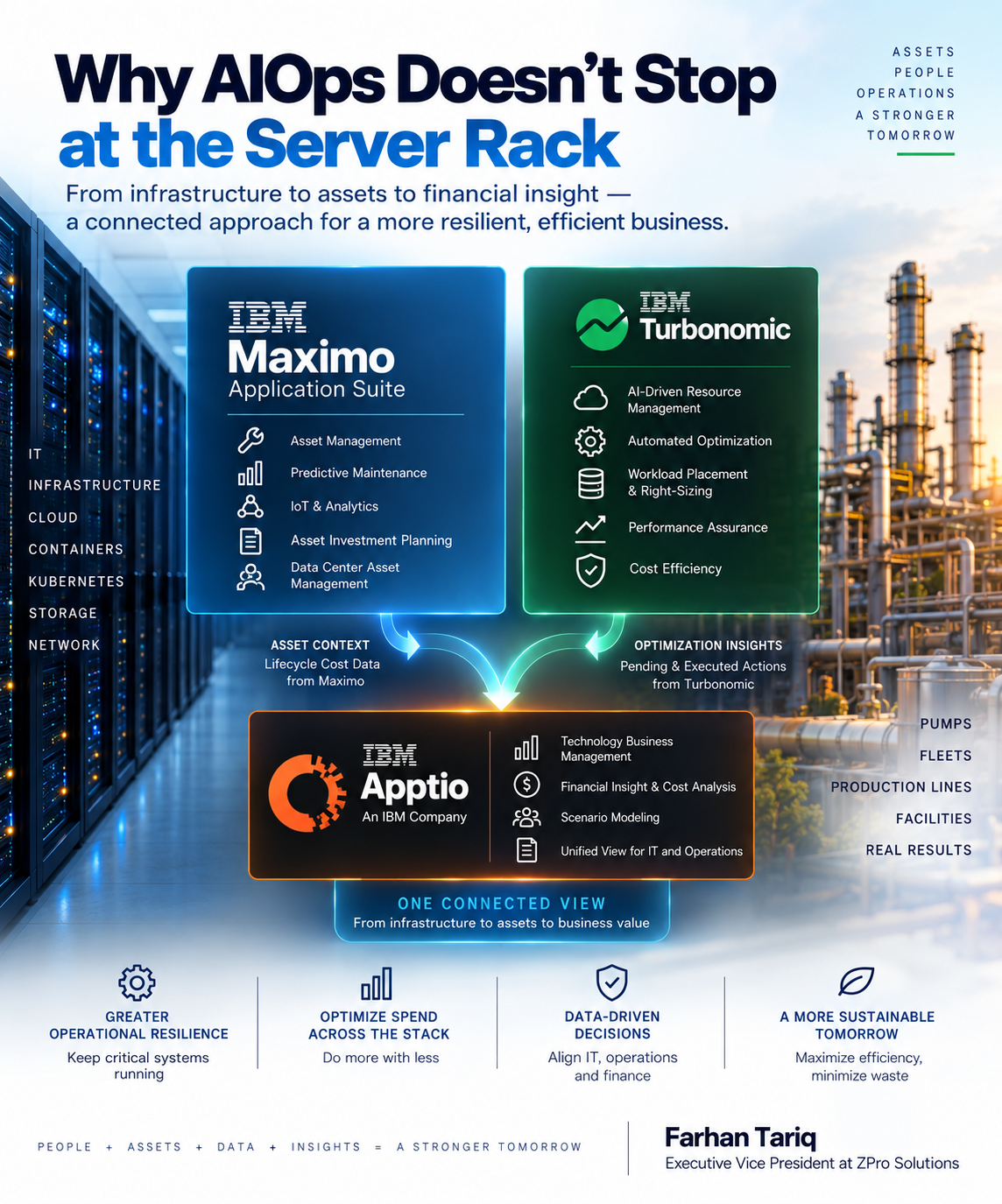
IBM’s ecosystem shows how different platforms address different layers of enterprise operations. IBM Maximo focuses on physical asset tracking, facility management, and lifecycle decisions, while Turbonomic focuses on enterprise IT infrastructure optimization.
Maximo’s Asset Investment Planning capability uses AI-driven insights, scenario modeling, and lifecycle cost analysis to help organizations make informed decisions about repairing, replacing, or investing in assets.
This connects asset management with broader technology business management (TBM) strategies, allowing organizations to understand not only asset conditions but also financial impact.
Turbonomic operates at the application and infrastructure layer by analyzing workloads, resources, and system performance. It uses machine learning algorithms and automated recommendations to improve:
Through continuous performance monitoring, Turbonomic helps organizations maintain real-time visibility into application and infrastructure requirements.
This supports modern environments built on:
While Turbonomic identifies optimization opportunities, Apptio translates those technical improvements into financial insights.
The connection supports:
By combining operational intelligence with financial analysis, organizations can evaluate the business impact of infrastructure decisions rather than focusing only on technical performance.
Modern AIOps platforms are moving beyond traditional monitoring. They combine advanced analytics with automation to improve operational efficiency.
Key capabilities include:
AI-driven systems analyze historical and real-time data to predict failures before they occur. This approach supports predictive maintenance for both digital systems and physical infrastructure.
Machine learning models identify unusual behavior across applications, networks, and infrastructure. Instead of responding only after failures occur, teams can perform faster root cause analysis and identify underlying issues.
AIOps enables automated remediation by recommending or executing corrective actions. This reduces manual intervention and improves operational reliability.
There is currently no direct operational connector between Turbonomic and Maximo because they operate at different layers of the technology ecosystem.
Maximo manages physical assets such as:
Turbonomic manages digital workloads, cloud resources, and infrastructure performance.
The connection happens through the broader technology business management (TBM) layer, where operational insights and lifecycle financial data can support strategic decisions.
The future of enterprise management depends on combining:
Organizations that connect IT infrastructure with operational assets gain better real-time visibility, stronger decision-making, and improved control over critical infrastructure.
AIOps is no longer limited to the server rack. It is becoming a complete intelligence layer connecting applications, cloud environments, physical assets, and business strategy.

Co-Founder, Cloud & Engineering Executive
Comments are closed